
Verdict Against Former Syrian Regime Officer for Crimes Against Humanity Is A Landmark Case
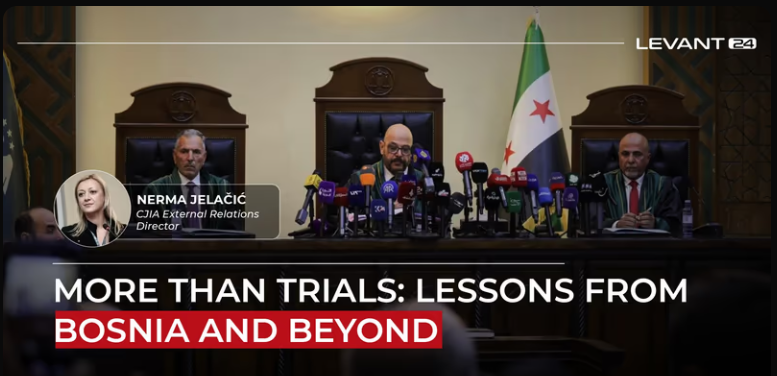
The Organization for World Peace reports on the conviction in the case of Eyad A, featuring commentary on the historic verdict by CIJA Director Nerma Jelacic.
The Organization for World Peace reports on the conviction in the case of Eyad A, featuring commentary on the historic verdict by CIJA Director Nerma Jelacic.
CIJA Speaks to CBC: The Current
CIJA Executive Director Bill Wiley speaks to CBC’s the Current on the occasion of the Eyad A ruling and discusses the significance of CIJA-secured linkage evidence to the conviction in the case.
Segment begins at 01:02:40
Listen here: The Current for March 4, 2021 | CBC Radio
CIJA Executive Director Bill Wiley speaks to CBC’s the Current on the occasion of the Eyad A ruling and discusses the significance of CIJA-secured linkage evidence to the conviction in the case.
Segment begins at 01:02:40
Listen here: The Current for March 4, 2021 | CBC Radio
CIJA Speaks to BBC World Service
CIJA Director Nerma Jelacic speaks to the BBC World Service about CIJA’s evidentiary assistance to German authorities in the case of Eyad A and war crimes units across Europe.
Segment begins at 00:27:00.
Listen here: BBC Sounds
CIJA Director Nerma Jelacic speaks to the BBC World Service about CIJA’s evidentiary assistance to German authorities in the case of Eyad A and war crimes units across Europe.
Segment begins at 00:27:00.
Listen here: BBC Sounds
Trial Report from CIJA Expert Testimony in Case of Anwar Raslan
The Syrian Justice and Accountability Centre has published a trial monitoring report of CIJA’s expert testimony in the case of Anwar Raslan before the Higher Regional Court in Koblenz, Germany.
The Syrian Justice and Accountability Centre has published a trial monitoring report of CIJA’s expert testimony in the case of Anwar Raslan before the Higher Regional Court in Koblenz, Germany.
In world first, Germany convicts Syrian regime officer of crimes against humanity
CNN reports on the first crimes against humanity conviction addressing torture in Syrian detention facilities and the role of CIJA evidence in the trial of Eyad A.
CNN reports on the first crimes against humanity conviction addressing torture in Syrian detention facilities and the role of CIJA evidence in the trial of Eyad A.
Koblenz court issues verdict in Eyad A. case
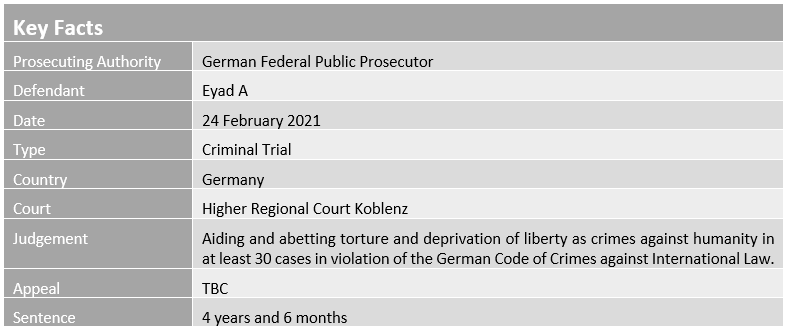
On 24 February, the Higher Regional Court in Koblenz, Germany convicted former Syrian secret service agent Eyad A. of aiding and abetting 30 counts of crimes against humanity committed in the early months of the 2011 uprising and sentenced him to four years and six months in prison.
Eyad A. is convicted for his role in a violent attack against protesters in September 2011 in Douma, which resulted in the deprivation of liberty and subsequent torture of at least 30 civilians at Branch 251 of the General Intelligence Directorate, located in the Al-Khatib neighborhood of Damascus.
At the time of the incident, Eyad A. was a low-ranking officer in Sub-Division 40 which, while formally subordinate to Branch 251, acted autonomously under the leadership of Hafez Makhlouf, a cousin of President Bashar al-Assad. The sub-division was responsible for suppressing demonstrations and operated checkpoints throughout Damascus and its surroundings.
The verdict constitutes the first crimes against humanity conviction of a former member of the Syrian Regime. The court also found that the crimes Eyad A. is convicted of were committed as part of the Syrian government’s widespread and systematic attack against its civilian population. Further, Eyad A. knew and accepted that his conduct would result in the torture of civilians and that his conduct was part of a widespread and systematic attack on the civilian population.
CIJA has supported the German Federal Police investigation of this case since 2017 and the prosecution since Eyad A.’s arrest in 2019. CIJA’s assistance came in the form of documentary evidence, witness as well as expert testimony. This assistance focused on the role and structure of both Branch 251 of the Syrian General Intelligence Directorate and Sub-Division 40.
The support provided by CIJA is based on original Regime documents as well as victim and insider witness accounts, secured by CIJA investigators in Syria. Of significant relevance to the. case were documents and insider witness accounts, confirming the position of Sub-Division 40 within the structure of Branch 251. In November 2020, CIJA’s Director of Operations and Investigations testified as an expert witness before the court in Koblenz. Over the course of the two-day testimony, CIJA provided a thorough contextual analysis of the Regime’s security-intelligence apparatus and its widespread and systematic use of torture in detention as well as of the role of Branch 251 and Sub-Division 40. The complex expert testimony included a courtroom presentation of over 60 slides summarising CIJA´s findings and evidence. A binder of CIJA documents was entered into evidence at the judges´ request following the testimony. These documents were read into record in subsequent days of the trials, including on the last day of the hearing.
Eyad A. was originally indicted and tried together with Anwar R., the former head of interrogations at Branch 251 of the Syrian General Intelligence Directorate. Following ten months of hearings, the court formally severed the Eyad A. case on 17 February 2021. The trial of Anwar R. continues.
CIJA has been investigating crimes committed in Syria since 2012. Since then, its teams of Syrian investigators have amassed over 1,000,000 pages of Syrian regime documentation constituting the largest cache of documentary evidence ever secured in the course of an ongoing conflict. To date, CIJA’s analysts have answered close to 600 requests for assistance from public authorities concerning over 2,000 individual targets. CIJA is currently cooperating with 15 ongoing investigations and provides continuous support to 36 law enforcement agencies from 13 countries.
Links and Media
Selected Court Documents
Official Press Release, 24 February 2021
Selected Media Coverage
Reuters, “German arrest is first big catch for Syria investigators”, 13 February 2019
NPR, "Why Are Syrian War Crimes Being Prosecuted in Germany?", 24 September 2019
Al Jazeera, "Landmark trial against alleged Syrian war criminals: What next?", 30 April 2020
The Washington Post, "German court case is first to try Syrian regime for war crimes", 23 April 2020
JusticeInfo, "Syria Trial in Germany: The orders that came from the very top", 26 November 2020
JusticeInfo, “Koblenz, the First Syria State Crimes Trial in Europe”, 14 December 2020

On 24 February, the Higher Regional Court in Koblenz, Germany convicted former Syrian secret service agent Eyad A. of aiding and abetting 30 counts of crimes against humanity committed in the early months of the 2011 uprising and sentenced him to four years and six months in prison.
Eyad A. is convicted for his role in a violent attack against protesters in September 2011 in Douma, which resulted in the deprivation of liberty and subsequent torture of at least 30 civilians at Branch 251 of the General Intelligence Directorate, located in the Al-Khatib neighborhood of Damascus.
At the time of the incident, Eyad A. was a low-ranking officer in Sub-Division 40 which, while formally subordinate to Branch 251, acted autonomously under the leadership of Hafez Makhlouf, a cousin of President Bashar al-Assad. The sub-division was responsible for suppressing demonstrations and operated checkpoints throughout Damascus and its surroundings.
The verdict constitutes the first crimes against humanity conviction of a former member of the Syrian Regime. The court also found that the crimes Eyad A. is convicted of were committed as part of the Syrian government’s widespread and systematic attack against its civilian population. Further, Eyad A. knew and accepted that his conduct would result in the torture of civilians and that his conduct was part of a widespread and systematic attack on the civilian population.
CIJA has supported the German Federal Police investigation of this case since 2017 and the prosecution since Eyad A.’s arrest in 2019. CIJA’s assistance came in the form of documentary evidence, witness as well as expert testimony. This assistance focused on the role and structure of both Branch 251 of the Syrian General Intelligence Directorate and Sub-Division 40.
The support provided by CIJA is based on original Regime documents as well as victim and insider witness accounts, secured by CIJA investigators in Syria. Of significant relevance to the. case were documents and insider witness accounts, confirming the position of Sub-Division 40 within the structure of Branch 251. In November 2020, CIJA’s Director of Operations and Investigations testified as an expert witness before the court in Koblenz. Over the course of the two-day testimony, CIJA provided a thorough contextual analysis of the Regime’s security-intelligence apparatus and its widespread and systematic use of torture in detention as well as of the role of Branch 251 and Sub-Division 40. The complex expert testimony included a courtroom presentation of over 60 slides summarising CIJA´s findings and evidence. A binder of CIJA documents was entered into evidence at the judges´ request following the testimony. These documents were read into record in subsequent days of the trials, including on the last day of the hearing.
Eyad A. was originally indicted and tried together with Anwar R., the former head of interrogations at Branch 251 of the Syrian General Intelligence Directorate. Following ten months of hearings, the court formally severed the Eyad A. case on 17 February 2021. The trial of Anwar R. continues.
CIJA has been investigating crimes committed in Syria since 2012. Since then, its teams of Syrian investigators have amassed over 1,000,000 pages of Syrian regime documentation constituting the largest cache of documentary evidence ever secured in the course of an ongoing conflict. To date, CIJA’s analysts have answered close to 600 requests for assistance from public authorities concerning over 2,000 individual targets. CIJA is currently cooperating with 15 ongoing investigations and provides continuous support to 36 law enforcement agencies from 13 countries.
Links and Media
Selected Court Documents
Official Press Release, 24 February 2021
Selected Media Coverage
Reuters, “German arrest is first big catch for Syria investigators”, 13 February 2019
NPR, "Why Are Syrian War Crimes Being Prosecuted in Germany?", 24 September 2019
Al Jazeera, "Landmark trial against alleged Syrian war criminals: What next?", 30 April 2020
The Washington Post, "German court case is first to try Syrian regime for war crimes", 23 April 2020
JusticeInfo, "Syria Trial in Germany: The orders that came from the very top", 26 November 2020
JusticeInfo, “Koblenz, the First Syria State Crimes Trial in Europe”, 14 December 2020
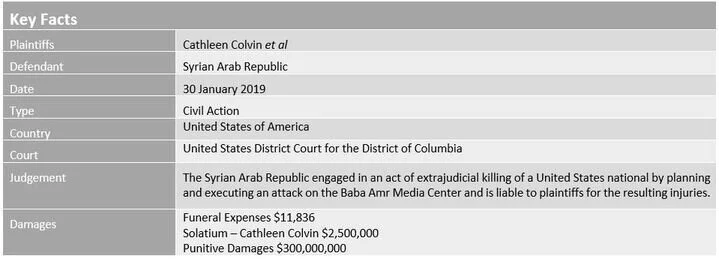
Colvin v Syrian Arab Republic
The judgement in “Colvin V. Syria” found the Syrian Arab Republic liable for the extrajudicial killing of US journalist Marie Colvin in a deliberate artillery attack against the Baba Amr Media Centre in Homs, on 22 February 2012, as part of “Syria’s long-standing policy of violence” used to target journalists and suppress dissent. In issuing its verdict, the court further awarded significant damages of over $ 302 million. The case was built by the Center for Justice and Accountability (CJA) on behalf of Colvin’s relatives. CIJA provided extensive evidentiary assistance including original Syrian Regime documents, access to insider witnesses and an expert report on the structures of Syria’s military and security-intelligence apparatus authored by CIJA’s Senior Military Analyst.
A landmark ruling on extrajudicial killing
The court found that Colvin’s extrajudicial killing constitutes a violation of the Foreign Sovereign Immunities Act, which allows victims or relatives of US citizens who have been subjected to killing and torture abroad by a foreign government to seek redress before a US court. The court’s opinion draws on a wide range of corroborating evidence to demonstrate the “comprehensive intelligence gathering effort” by the Syrian Regime to identify the whereabouts of foreign journalists, including Colvin, in the besieged neighborhood of Baba Amr in Homs. Once their location in the Media Center in Baba Amr was uncovered, the Regime proceeded to launch an artillery attack against the premises “for the purpose of killing the journalists inside”. The attack resulted in the killing of Colvin and French photographer Remi Ochlik. Many other journalists and activists in the building were left severely wounded; it is reported that over eighty civilians were killed in attacks directed against Baba Amr, on the same day.
Exposing the Syrian Regime’s system of violent suppression
The judgement in “Colvin v Syria Arabic Republic” is also significant as it represents the first verdict to hold the Syrian Regime responsible for atrocities committed amid the country’s decade-long war. While the suit was focused directly on the events in Baba Amr, it provided an unprecedented opportunity to judicially examine extensive evidence regarding the systematic and highly regulated nature of the Regime’s campaign to quell civil decent from the very start of the conflict. The court’s opinion provides a wide-ranging examination of the Syrian Regime’s response to the 2011 popular uprising and suppression of independent and foreign media, finding that the level of violence was extreme.
Evidence Base
The civil complaint was built over a number of years and its evidentiary base rests on a wide array of analytical reports, original Syrian Regime documentation and witness statements. Expert reports outlining Syrian politics and policies based on the authors´ subject matter expertise, diplomatic cables and UN reports were provided by then United Nations Special Rapporteur on the Promotion and Protection of the Right to Freedom of Opinion and Expression, David Kaye and former US Ambassador to Syria, Robert Ford. An additional expert report on economic damages was provided by Dr. Maria Tsennykh as part of the complaint.
The centerpiece of CIJA´s contribution to the case was a 132-page expert report on the command-and-control structures of Syria´s government and security-intelligence apparatus authored by CIJA’s Senior Military Analyst. The report drew on the vast array of documents collected by Syrian field investigators since 2011 in order to form a complete contextual understanding of the Regime’s attack on Baba Amr. The court’s opinion extensively cites CIJA’s work in its findings, which established inter alia the role of the Central Crisis Management Cell, the highest national security body in the Syrian Regime, in directing the Regime’s violent response to the uprising in general and in overseeing the Homs Military and Security Committee in particular; the command and control responsibility of Major General Rafiq Shahadah, in coordinating military and intelligence operations in the siege of Baba Amr; the widespread and systematic violence directed against the civilian population as well as those who “tarnish[ed] the image of Syria in the foreign media and international organizations.” In addition to the expert report, CIJA´s assistance included providing access to two former Regime members with insider knowledge of the attacks on Baba Amr as well as over 200 documents.
Links and Media
Selected Court Documents
Amended Memorandum Opinion of US District Court for the District of Columbia
List of Other Evidence and Pleadings
Selected Media Coverage
The Independent, “Marie deserved the truth': Assad regime deliberately targeted and killed journalist Colvin, investigation claims”, 9 April 2018
The Intercept, “Target Journalist. How the Assad Regime Tracked and Killed Marie Colvin for Reporting on War Crimes in Syria”, 9 April 2018
NPR, “Syrian Defector: Assad Forces Targeted, Killed Journalist Marie Colvin”, 10 April 2018
The Times, “Target Journalist: The killing of reporters should be classified as a war crime”, 5 April 2018
The New York Times, “Syrian Forces Aimed to Kill Journalists, U.S. Court Is Told”, 9 April 2018
The New York Times, “Syria Ordered to Pay $302.5 Million to Family of Marie Colvin”, 31 January 2019

The judgement in “Colvin V. Syria” found the Syrian Arab Republic liable for the extrajudicial killing of US journalist Marie Colvin in a deliberate artillery attack against the Baba Amr Media Centre in Homs, on 22 February 2012, as part of “Syria’s long-standing policy of violence” used to target journalists and suppress dissent. In issuing its verdict, the court further awarded significant damages of over $ 302 million. The case was built by the Center for Justice and Accountability (CJA) on behalf of Colvin’s relatives. CIJA provided extensive evidentiary assistance including original Syrian Regime documents, access to insider witnesses and an expert report on the structures of Syria’s military and security-intelligence apparatus authored by CIJA’s Senior Military Analyst.
A landmark ruling on extrajudicial killing
The court found that Colvin’s extrajudicial killing constitutes a violation of the Foreign Sovereign Immunities Act, which allows victims or relatives of US citizens who have been subjected to killing and torture abroad by a foreign government to seek redress before a US court. The court’s opinion draws on a wide range of corroborating evidence to demonstrate the “comprehensive intelligence gathering effort” by the Syrian Regime to identify the whereabouts of foreign journalists, including Colvin, in the besieged neighborhood of Baba Amr in Homs. Once their location in the Media Center in Baba Amr was uncovered, the Regime proceeded to launch an artillery attack against the premises “for the purpose of killing the journalists inside”. The attack resulted in the killing of Colvin and French photographer Remi Ochlik. Many other journalists and activists in the building were left severely wounded; it is reported that over eighty civilians were killed in attacks directed against Baba Amr, on the same day.
Exposing the Syrian Regime’s system of violent suppression
The judgement in “Colvin v Syria Arabic Republic” is also significant as it represents the first verdict to hold the Syrian Regime responsible for atrocities committed amid the country’s decade-long war. While the suit was focused directly on the events in Baba Amr, it provided an unprecedented opportunity to judicially examine extensive evidence regarding the systematic and highly regulated nature of the Regime’s campaign to quell civil decent from the very start of the conflict. The court’s opinion provides a wide-ranging examination of the Syrian Regime’s response to the 2011 popular uprising and suppression of independent and foreign media, finding that the level of violence was extreme.
Evidence Base
The civil complaint was built over a number of years and its evidentiary base rests on a wide array of analytical reports, original Syrian Regime documentation and witness statements. Expert reports outlining Syrian politics and policies based on the authors´ subject matter expertise, diplomatic cables and UN reports were provided by then United Nations Special Rapporteur on the Promotion and Protection of the Right to Freedom of Opinion and Expression, David Kaye and former US Ambassador to Syria, Robert Ford. An additional expert report on economic damages was provided by Dr. Maria Tsennykh as part of the complaint.
The centerpiece of CIJA´s contribution to the case was a 132-page expert report on the command-and-control structures of Syria´s government and security-intelligence apparatus authored by CIJA’s Senior Military Analyst. The report drew on the vast array of documents collected by Syrian field investigators since 2011 in order to form a complete contextual understanding of the Regime’s attack on Baba Amr. The court’s opinion extensively cites CIJA’s work in its findings, which established inter alia the role of the Central Crisis Management Cell, the highest national security body in the Syrian Regime, in directing the Regime’s violent response to the uprising in general and in overseeing the Homs Military and Security Committee in particular; the command and control responsibility of Major General Rafiq Shahadah, in coordinating military and intelligence operations in the siege of Baba Amr; the widespread and systematic violence directed against the civilian population as well as those who “tarnish[ed] the image of Syria in the foreign media and international organizations.” In addition to the expert report, CIJA´s assistance included providing access to two former Regime members with insider knowledge of the attacks on Baba Amr as well as over 200 documents.
Links and Media
Selected Court Documents
Amended Memorandum Opinion of US District Court for the District of Columbia
List of Other Evidence and Pleadings
Selected Media Coverage
The Independent, “Marie deserved the truth': Assad regime deliberately targeted and killed journalist Colvin, investigation claims”, 9 April 2018
The Intercept, “Target Journalist. How the Assad Regime Tracked and Killed Marie Colvin for Reporting on War Crimes in Syria”, 9 April 2018
NPR, “Syrian Defector: Assad Forces Targeted, Killed Journalist Marie Colvin”, 10 April 2018
The Times, “Target Journalist: The killing of reporters should be classified as a war crime”, 5 April 2018
The New York Times, “Syrian Forces Aimed to Kill Journalists, U.S. Court Is Told”, 9 April 2018
The New York Times, “Syria Ordered to Pay $302.5 Million to Family of Marie Colvin”, 31 January 2019
Handcuffed to the truth
In an exclusive report marking the tenth anniversary of the Syrian uprising, CBS 60 Minutes sits down with Ambassador Stephen Rapp, Chair of CIJA’s Board of Commissioners, to discuss CIJA’s efforts to bring Syrian perpetrators to account and the strength of the evidence collected by CIJA’s Syrian investigators to date: “We've got better evidence-- against Assad and his clique-- than we had against Milosevic in Yugoslavia…even better than we had against the Nazis at Nuremberg, because the Nazis didn't actually take individual pictures of each of their victims with identifying information on them.”
In an exclusive report marking the tenth anniversary of the Syrian uprising, CBS 60 Minutes sits down with Ambassador Stephen Rapp, Chair of CIJA’s Board of Commissioners, to discuss CIJA’s efforts to bring Syrian perpetrators to account and the strength of the evidence collected by CIJA’s Syrian investigators to date: “We've got better evidence-- against Assad and his clique-- than we had against Milosevic in Yugoslavia…even better than we had against the Nazis at Nuremberg, because the Nazis didn't actually take individual pictures of each of their victims with identifying information on them.”
CIJA participates in the UN Team of Experts on Sexual Violence in Conflict's Fifth Digital Dialogue
On 25 January, CIJA Senior Advisor on sexual and gender-based violence, Stephanie Barbour, participated as a panelist in the UN Team of Experts on Rule of Law and Sexual Violence in Conflict´s Fifth Digital Dialogue entitled “The importance of a label: understanding the impunity gap for conflict-related sexual violence crimes associated with slavery and trafficking."
The event juxtaposed and explored critical intersections in the investigation of the crimes of slavery, the slave trade and trafficking. In her remarks, Barbour discussed the challenges of investigating the slave trade of women and children by Islamic State (IS) in Northern Iraq and Syria and outlined the elements of CIJA´s large-scale situational investigation model, which enabled the collection of critical multi-layered, corroborative evidence of IS enslavement practices. Drawing on her recent contribution to the Special Issue of the Journal of International Criminal Justice, Barbour also presented the strategies CIJA has adopted to ensure that its collections meet criminal evidentiary standards irrespective of the jurisdiction in which they are to be used, as well as the organisation´s analytical approaches to characterising the crimes of enslavement, slave trade and trafficking under different domestic and international legal regimes.
During the event, moderated by Patricia Viseur Sellers, Special Advisor for Gender for the Office of the Prosecutor of the International Criminal Court, Barbour was joined by panelists Ameena Saeed, former Iraqi MP, Yezidi Kurd advocate on trafficking and slavery; Jocelyn Getgen Kestenbaum, Professor of Law, Cardozo Law School; Aimee Comrie, Project Coordinator for GLO.ACT Asia and the Middle East, UNODC; and Valiant Richey, OSCE Special Representative and Coordinator for Combating Trafficking in Human Beings.
A video recording of the Dialogue is available here. Stephanie Barbour’s presentation starts at 17:11.
On 25 January, CIJA Senior Advisor on sexual and gender-based violence, Stephanie Barbour, participated as a panelist in the UN Team of Experts on Rule of Law and Sexual Violence in Conflict´s Fifth Digital Dialogue entitled “The importance of a label: understanding the impunity gap for conflict-related sexual violence crimes associated with slavery and trafficking."
The event juxtaposed and explored critical intersections in the investigation of the crimes of slavery, the slave trade and trafficking. In her remarks, Barbour discussed the challenges of investigating the slave trade of women and children by Islamic State (IS) in Northern Iraq and Syria and outlined the elements of CIJA´s large-scale situational investigation model, which enabled the collection of critical multi-layered, corroborative evidence of IS enslavement practices. Drawing on her recent contribution to the Special Issue of the Journal of International Criminal Justice, Barbour also presented the strategies CIJA has adopted to ensure that its collections meet criminal evidentiary standards irrespective of the jurisdiction in which they are to be used, as well as the organisation´s analytical approaches to characterising the crimes of enslavement, slave trade and trafficking under different domestic and international legal regimes.
During the event, moderated by Patricia Viseur Sellers, Special Advisor for Gender for the Office of the Prosecutor of the International Criminal Court, Barbour was joined by panelists Ameena Saeed, former Iraqi MP, Yezidi Kurd advocate on trafficking and slavery; Jocelyn Getgen Kestenbaum, Professor of Law, Cardozo Law School; Aimee Comrie, Project Coordinator for GLO.ACT Asia and the Middle East, UNODC; and Valiant Richey, OSCE Special Representative and Coordinator for Combating Trafficking in Human Beings.
A video recording of the Dialogue is available here. Stephanie Barbour’s presentation starts at 17:11.
The Hunt for the Guilty
In 2020, CIJA provided information on over 500 suspects to Western authorities investigating war crimes in Syria and Iraq. Bill Wiley takes Deutschlandfunk Kultur inside CIJA´s evidence archive supporting investigations and prosecutions such as the Al-Khatib trial in Koblenz, Germany.
In 2020, CIJA provided information on over 500 suspects to Western authorities investigating war crimes in Syria and Iraq. Bill Wiley takes Deutschlandfunk Kultur inside CIJA´s evidence archive supporting investigations and prosecutions such as the Al-Khatib trial in Koblenz, Germany.
How the highest-ranking Syrian regime suspect tracked by CIJA evaded arrest
In late 2015, CIJA located Brigadier General Khaled Al-Halabi, a former high ranking Syrian regime officer suspected of crimes against humanity, in Vienna. In January 2016, CIJA informed Austrian authorities that the suspect – the highest-ranking Syrian regime official known to be in Europe – was on their territory.
Al-Halabi was the Head of General Intelligence Branch 335 in Raqqa from at least 2009 until 02 March 2013, two days prior to the fall of Raqqa to Syrian opposition forces. Together, the extant evidence held by the CIJA demonstrates that Al-Halabi exercised de jure and de facto control over all aspects of the functioning of Branch 335. The evidence illustrates that egregious crimes against humanity, including murder and torture, along with sexual offences, were perpetrated in Branch 335 by subordinates of Al-Halabi, with his knowledge.
The likely presence of Al-Halabi in Austria was discovered by CIJA’s investigators and then verified and narrowed down to an address in Vienna in late 2015 by a nascent unit of cyber and tracking analysts. Concurrently, a legal brief outlining Al-Halabi’s individual criminal responsibility for a range of crimes against humanity committed under his control and with his full knowledge was created by analysts and legal advisers. The legal brief rests on Syrian regime documentation and witness statements, many of which came from insider witnesses.
In January 2016, the CIJA established contact with Austria’s Federal Ministry of Justice (MoJ) indicating that it had information on a high-ranking, suspected Syrian regime perpetrator of core international crimes, who was present on Austrian territory. CIJA representatives met with the MoJ on 29 January 2016, with a number of follow-up meetings taking place later that year. The complete Al-Halabi dossier was shared with Austrian authorities.
CIJA was able to build its dossier on Al-Halabi using its unprecedented evidence holdings and rigorous analytical understanding of the perpetrating structures of the Syrian Regime, as well as Islamic State. It uses this information and analytical capacity to support numerous investigations and cases in Europe. This includes assisting over 30 law enforcement agencies from 13 countries: since 2016 CIJA has received in excess of 550 Requests for Assistance, concerning nearly 2,000 Syrian regime and Islamic State suspects – many of them present in Schengen Zone States. It has also provided evidence and testimony used in court cases that have resulted in convictions of the accused.
CIJA regards the evidence against Al-Halabi as being particularly damning. Moreover he is, most certainly, the highest-ranking and most culpable (in terms of alleged criminality) suspect who remains at large in the West.
CIJA does not normally comment on cases under investigation nor does it seek to publicise its role until charges are raised or arrests made. The Al-Halabi case is different. Since 2018, third parties have leaked the existence of and details about the investigation to Austrian press, while extensive nationwide and international coverage appeared in November 2020.
Reporting by The Daily Telegraph explores some of the potential reasons for a lack of definitive action by Austrian authorities over the past five years. For further detail, see here or here.
In late 2015, CIJA located Brigadier General Khaled Al-Halabi, a former high ranking Syrian regime officer suspected of crimes against humanity, in Vienna. In January 2016, CIJA informed Austrian authorities that the suspect – the highest-ranking Syrian regime official known to be in Europe – was on their territory.
Al-Halabi was the Head of General Intelligence Branch 335 in Raqqa from at least 2009 until 02 March 2013, two days prior to the fall of Raqqa to Syrian opposition forces. Together, the extant evidence held by the CIJA demonstrates that Al-Halabi exercised de jure and de facto control over all aspects of the functioning of Branch 335. The evidence illustrates that egregious crimes against humanity, including murder and torture, along with sexual offences, were perpetrated in Branch 335 by subordinates of Al-Halabi, with his knowledge.
The likely presence of Al-Halabi in Austria was discovered by CIJA’s investigators and then verified and narrowed down to an address in Vienna in late 2015 by a nascent unit of cyber and tracking analysts. Concurrently, a legal brief outlining Al-Halabi’s individual criminal responsibility for a range of crimes against humanity committed under his control and with his full knowledge was created by analysts and legal advisers. The legal brief rests on Syrian regime documentation and witness statements, many of which came from insider witnesses.
In January 2016, the CIJA established contact with Austria’s Federal Ministry of Justice (MoJ) indicating that it had information on a high-ranking, suspected Syrian regime perpetrator of core international crimes, who was present on Austrian territory. CIJA representatives met with the MoJ on 29 January 2016, with a number of follow-up meetings taking place later that year. The complete Al-Halabi dossier was shared with Austrian authorities.
CIJA was able to build its dossier on Al-Halabi using its unprecedented evidence holdings and rigorous analytical understanding of the perpetrating structures of the Syrian Regime, as well as Islamic State. It uses this information and analytical capacity to support numerous investigations and cases in Europe. This includes assisting over 30 law enforcement agencies from 13 countries: since 2016 CIJA has received in excess of 550 Requests for Assistance, concerning nearly 2,000 Syrian regime and Islamic State suspects – many of them present in Schengen Zone States. It has also provided evidence and testimony used in court cases that have resulted in convictions of the accused.
CIJA regards the evidence against Al-Halabi as being particularly damning. Moreover he is, most certainly, the highest-ranking and most culpable (in terms of alleged criminality) suspect who remains at large in the West.
CIJA does not normally comment on cases under investigation nor does it seek to publicise its role until charges are raised or arrests made. The Al-Halabi case is different. Since 2018, third parties have leaked the existence of and details about the investigation to Austrian press, while extensive nationwide and international coverage appeared in November 2020.
Reporting by The Daily Telegraph explores some of the potential reasons for a lack of definitive action by Austrian authorities over the past five years. For further detail, see here or here.
Bolstering international criminal investigations
In a recent publication, CIJA Executive Director, William Wiley and CIJA Chief Analyst, Ewan Brown examine the challenges faced by international prosecutors responsible for the investigation of complex crimes. The authors, both of whom have decades of experience in international investigations, review the investigative practices of the ICTY, ICTR and ICC, analysing both their strengths and shortcomings. The article notes that current international justice institutions have failed to heed the lessons of their predecessors thereby perpetuating poor judicial outcomes. Drawing on the authors´ rich experience gathered in international courts and tribunals as well as CIJA, the authors outline strategies for effective staffing, planning and management of the collection of crime base as well as linkage evidence, arguing for innovation in the gathering of contextual evidence and for more robust evidence review processes in complex criminal investigations.
Reference: Ewan Brown and William H. Wiley, “International Criminal Investigative Collection Planning, Collection Management and Evidence Review”, in Xabier Agirre Aranburu, Morten Bergsmo, Simon De Smet and Carsten Stahn (editors), Quality Control in Criminal Investigation, Torkel Opsahl Academic EPublisher, Brussels, 2020
In a recent publication, CIJA Executive Director, William Wiley and CIJA Chief Analyst, Ewan Brown examine the challenges faced by international prosecutors responsible for the investigation of complex crimes. The authors, both of whom have decades of experience in international investigations, review the investigative practices of the ICTY, ICTR and ICC, analysing both their strengths and shortcomings. The article notes that current international justice institutions have failed to heed the lessons of their predecessors thereby perpetuating poor judicial outcomes. Drawing on the authors´ rich experience gathered in international courts and tribunals as well as CIJA, the authors outline strategies for effective staffing, planning and management of the collection of crime base as well as linkage evidence, arguing for innovation in the gathering of contextual evidence and for more robust evidence review processes in complex criminal investigations.
Reference: Ewan Brown and William H. Wiley, “International Criminal Investigative Collection Planning, Collection Management and Evidence Review”, in Xabier Agirre Aranburu, Morten Bergsmo, Simon De Smet and Carsten Stahn (editors), Quality Control in Criminal Investigation, Torkel Opsahl Academic EPublisher, Brussels, 2020
The CIJA Model – an example of public-private partnership in justice
CIJA’s origins, mandate, operational modus operandi, leadership and staffing are forensically explored in CIJA Executive Director Dr William H. Wiley’s contribution to Quality Control in Fact-Finding. The chapter examines the key challenges plaguing the field of international criminal justice – chief among them the inability of public sector bodies to physically access areas amid ongoing conflict and collect the evidence required for successful criminal prosecutions. “The system of international(ised) criminal justice might be saved in something like its current form – and indeed strengthened – only through the establishment of effective public–private partnerships at the investigative stage,” Dr Wiley writes in the 44-page chapter. Civil society actors can provide the agility and cost effectiveness which public sector bodies such as international(ised) courts often lack, however they need to have the capacity and willingness to work to a criminal-evidence standard in service of public sector bodies. The article also details CIJA’s relationship with public sector investigative and prosecutorial authorities, noting their eagerness to explore this shift in power dynamic as demonstrated by increasing requests for assistance as well as use of CIJA evidence in the courtrooms.
Reference: William H. Wiley, “International(ised) Criminal Justice at a Crossroads: The Role of Civil Society in the Investigation of Core International Crimes and the ‘CIJA Model´” in Morten Bergsmo and Carsten Stahn (editors), Quality Control in Fact-Finding, Second Edition, Torkel Opsahl Academic EPublisher, Brussels, 2020
CIJA’s origins, mandate, operational modus operandi, leadership and staffing are forensically explored in CIJA Executive Director Dr William H. Wiley’s contribution to Quality Control in Fact-Finding. The chapter examines the key challenges plaguing the field of international criminal justice – chief among them the inability of public sector bodies to physically access areas amid ongoing conflict and collect the evidence required for successful criminal prosecutions. “The system of international(ised) criminal justice might be saved in something like its current form – and indeed strengthened – only through the establishment of effective public–private partnerships at the investigative stage,” Dr Wiley writes in the 44-page chapter. Civil society actors can provide the agility and cost effectiveness which public sector bodies such as international(ised) courts often lack, however they need to have the capacity and willingness to work to a criminal-evidence standard in service of public sector bodies. The article also details CIJA’s relationship with public sector investigative and prosecutorial authorities, noting their eagerness to explore this shift in power dynamic as demonstrated by increasing requests for assistance as well as use of CIJA evidence in the courtrooms.
Reference: William H. Wiley, “International(ised) Criminal Justice at a Crossroads: The Role of Civil Society in the Investigation of Core International Crimes and the ‘CIJA Model´” in Morten Bergsmo and Carsten Stahn (editors), Quality Control in Fact-Finding, Second Edition, Torkel Opsahl Academic EPublisher, Brussels, 2020
CIJA contributes to expert volume on Integrity in International Justice
CIJA’s Executive Director, Dr William H Wiley, has used his rich experience in the international criminal justice system to analyse some of the underlying reasons for poor output of investigative divisions of international courts and tribunals. In an article published in the Torkel Opsahl Academic EPublisher volume Integrity in International Justice, Dr Wiley examines the relationship between leadership and management of international criminal investigative bodies and their effective performance, most specifically in the context of the conduct of complex criminal investigations.
Informed by Dr Wiley’s professional experience with the formative institutions of the era, including the ICTY, the ICTR and the ICC, the discussion considers the roots of international criminal investigative insufficiency. The chapter identifies the importance of institutional loyalty as an essential feature of an effective prosecutorial effort and demonstrates how failures of discipline serve to undermine the proper functioning of offices of the prosecutor and, most especially, their investigations divisions. Through a careful consideration of examples of successful as well as insufficient leadership witnessed at the ICTY, the ICTR and the ICC, the chapter illuminates the necessary intersection of strong leadership and professional integrity in the execution of effective international criminal investigations.
Integrity in International Justice is part of The Nuremberg Academy Series of publications on international law and features chapters by Richard Goldstone, Brigid Inder and Karim Khan among others.
Reference: William H. Wiley, “Effective Leadership, Management and Integrity in International Criminal Investigations”, in Morten Bergsmo and Viviane E. Dittrich (editors), Integrity in International Justice, Torkel Opsahl Academic EPublisher, Brussels, 2020
CIJA’s Executive Director, Dr William H Wiley, has used his rich experience in the international criminal justice system to analyse some of the underlying reasons for poor output of investigative divisions of international courts and tribunals. In an article published in the Torkel Opsahl Academic EPublisher volume Integrity in International Justice, Dr Wiley examines the relationship between leadership and management of international criminal investigative bodies and their effective performance, most specifically in the context of the conduct of complex criminal investigations.
Informed by Dr Wiley’s professional experience with the formative institutions of the era, including the ICTY, the ICTR and the ICC, the discussion considers the roots of international criminal investigative insufficiency. The chapter identifies the importance of institutional loyalty as an essential feature of an effective prosecutorial effort and demonstrates how failures of discipline serve to undermine the proper functioning of offices of the prosecutor and, most especially, their investigations divisions. Through a careful consideration of examples of successful as well as insufficient leadership witnessed at the ICTY, the ICTR and the ICC, the chapter illuminates the necessary intersection of strong leadership and professional integrity in the execution of effective international criminal investigations.
Integrity in International Justice is part of The Nuremberg Academy Series of publications on international law and features chapters by Richard Goldstone, Brigid Inder and Karim Khan among others.
Reference: William H. Wiley, “Effective Leadership, Management and Integrity in International Criminal Investigations”, in Morten Bergsmo and Viviane E. Dittrich (editors), Integrity in International Justice, Torkel Opsahl Academic EPublisher, Brussels, 2020
Laws to catch human-rights abusers are growing teeth
The Economist’s deep dive on the growing application of universal jurisdiction as a means to secure accountability for serious crimes in Syria and the role of CIJA evidence in domestic efforts to hold perpetrators accountable.
The Economist’s deep dive on the growing application of universal jurisdiction as a means to secure accountability for serious crimes in Syria and the role of CIJA evidence in domestic efforts to hold perpetrators accountable.